The Shadow of the Court
Almost no separating family gets a parenting order from a judge. Every one of them bargains under the rules a judge would use. On 6 May 2024 those rules changed.
Almost no separating family gets a parenting order from a judge. Every one of them bargains under the rules a judge would use. On 6 May 2024 those rules changed.
Here is a fact most people get wrong. In Australia, parenting arrangements are made by court order in about three per cent of family law matters. That figure includes orders made by consent. Ninety seven families in a hundred sort out who the kids live with somewhere else: a kitchen table, a mediator's room, a lawyer's letter, a text message at eleven at night.
So when people talk about "the family court" deciding what happens to fathers, they are mostly talking about a building most fathers never enter.
And yet I think the court decides far more than three per cent of it. That is what this series is about.
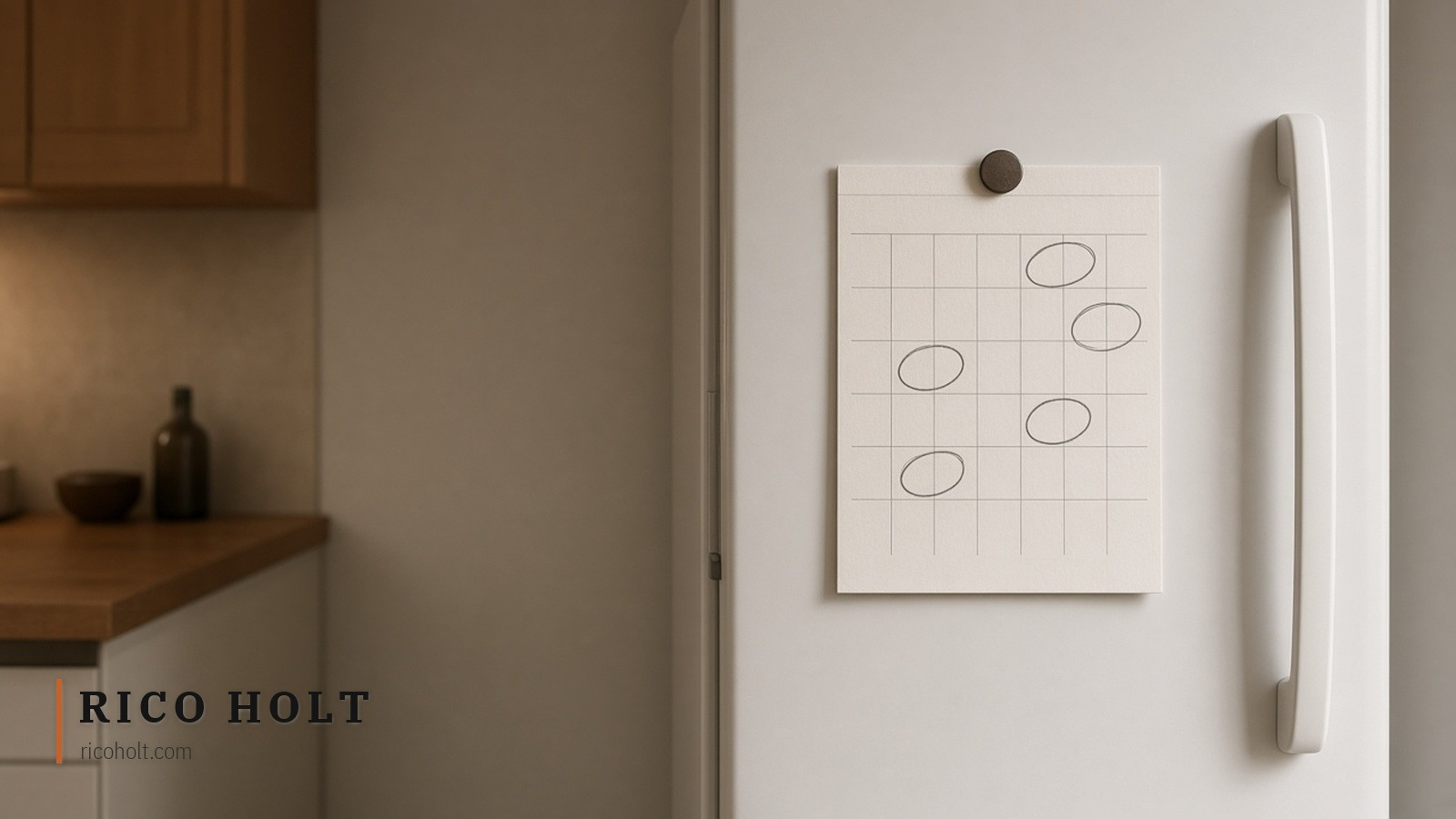
Picture a composite couple. They are not real people, and nothing here comes from any real family or case. Call them the two parents at the table. They have separated. They have two kids, a lease that ends in March, and a calendar stuck to the fridge with a magnet from a pizza shop.
They are trying to be decent. They do not want lawyers. They want to divide the weeks.
But they are not dividing the weeks in a vacuum. Each of them has been reading. Each of them has a cousin who went through it. Each of them has a rough idea of what a judge would do if they could not agree. And that rough idea sets the starting point of every offer across that table.
Lawyers have a phrase for this: bargaining in the shadow of the law. You do not need to go to court for the court to shape your deal. You only need to believe you know what would happen if you did.
That is why the law matters for the 97 families as much as the three. The defaults the law sets are the defaults people bargain from.
From 2006 until 2024, the Family Law Act told courts to start from a presumption that it was in a child's best interests for both parents to have equal shared parental responsibility. That meant shared responsibility for the big long term decisions: school, health, religion, where the child lives. The presumption did not apply where there were reasonable grounds to believe there had been child abuse or family violence, and it could be rebutted with evidence.
Attached to it was a second rule. Where a court made an order for equal shared parental responsibility, it had to consider whether equal time with each parent was in the child's best interests and reasonably practicable, and if not, whether "substantial and significant" time was.
Read that again, because this is where the confusion lived. The presumption was about decisions, not hours. But the equal time consideration sat right next to it, and in the public mind the two fused into one idea: the law starts at fifty fifty.
The Australian Law Reform Commission, in its 2019 report Family Law for the Future, recommended that the presumption be replaced with a presumption of joint decision making about major long term issues, and that the equal time provision be repealed. A parliamentary committee later noted that, "despite some confusion", it was "not a presumption about the amount of time" a child spends with each parent.
The Family Law Amendment Act 2023 received Royal Assent on 6 November 2023, and its parenting changes started on 6 May 2024. It removed the presumption of equal shared parental responsibility. It repealed the section that told courts to consider equal time. It did not adopt the replacement the law reform commission had proposed: the government said plainly it was not proposing a presumption of joint decision making. The parliament took the repeal and left the replacement out. Official guidance now spells it out: joint decision making "does not mean a child must spend equal time with each parent".
Supporters said this put the child, not the parents' claims, at the centre, and made the law safer where there is violence. That is a serious argument and I take it seriously.
This next part is my opinion. Label it that way when you argue with me.
I think the old law, for all its confusion, put a sentence in every separating father's head: the starting point is that you are still a full parent. Not a visitor. Not the weekend guy. A full parent, unless someone shows otherwise.
I think the new law took that sentence out, and replaced it with something that is legally sound and practically vague: it depends on the child's best interests. Which is right. And which, at the kitchen table, gives the person who already has most of the nights the stronger position, because "keep things stable" sounds like the child's interests and "change things" sounds like the parent's.
I think a culture that has come to see the father as the optional parent, the helper, the one who "babysits" his own kids, reads that vagueness one way more often than the other. That is the larger thesis of this series, and it is an argument, not a finding.
Now let me do what I promised and test it.
First: the courts were never handing out fifty fifty. Research by the Australian Institute of Family Studies, summarised in a 2022 report, found that in matters judges decided under the old law, orders for sole parental responsibility to one parent were more common than shared responsibility, 45 per cent against 40 per cent. Shared time orders were made in 17 per cent of judge-made orders. Shared time was most common, at 33 per cent, in orders made entirely by consent with no litigation. The presumption I just credited with putting a sentence in fathers' heads did not put fifty fifty into judgments.
Second: on the government's own figures given to parliament, fathers do better in court than outside it. Where a court determines the parenting orders, fathers have no contact in 3 per cent of cases, against 9 per cent in the separated population generally. Children spend the majority of their time with their father in 10 to 19 per cent of court-determined orders, against 2 per cent in the separated population. If the courtroom were the place where men are pushed out, you would expect the opposite.
Third: the families who do go to court are a hard group. Around 38.1 per cent of parents who resolved parenting matters through the court reported four or more complex issues, such as family violence, mental ill health or substance use. A system built for the worst cases will look harsh to anyone who sees only the outcome and not the file.
So where does that leave my argument? Narrower, and I think more honest. The case is not that judges hate fathers. The evidence does not support that. The case is that the law's defaults travel far beyond the courtroom, into the 97 per cent, and that the defaults now say less about fathers than they used to. Whether that pushes fathers out at the kitchen table is a question nobody has measured yet, because the change is only two and a half years old. I will keep looking for the data, and if it comes back against me, you will read it here first.
One more piece of machinery, because it sits under everything that follows.
Child support in Australia is worked out by formula, not by a judge. The formula combines both parents' incomes and the share of nights each parent has the children. Below 14 per cent of nights, up to 51 a year, a parent gets no recognition for the cost of care. From 14 per cent, 52 nights, care is "regular". From 35 per cent, 128 nights, it is "shared", and the cost recognition starts to climb.
On figures given to the parliament in 2021, 89 per cent of child support payers were male and 89 per cent of payees were female. Payees had a median adjusted taxable income of $23,953; payers, $47,985. About 60 per cent of payees received some income support.
Put the formula and the calendar on the same kitchen table and you can see the problem. Every night on the fridge calendar is also a number in an assessment. Two decent parents trying to share the weeks are also, whether they say it or not, negotiating a payment. I do not think that makes either of them greedy. I think it makes the system a third party at the table that neither of them invited.
Every week I will take one part of the machine: the Act, the court, the report writer, the formula, the enforcement that does not enforce. I will tell you what it says, what the evidence shows, and where I think it leans. When I am giving you my opinion, I will say so. When the evidence cuts against me, I will put it on the page.
No villains. Not mothers, not fathers, not judges. Just a system, the incentives it sets, and the families who live under its shadow without ever seeing the inside of the building.
Next week: the presumption that left, and the arguments on both sides of the debate that removed it.
If this was worth your time, you can leave a tip.
Get the next one in your inbox: ricoholt.com/list
Composite: the couple at the table is a composite drawn from no single family. Nothing in this piece describes any real person, judge or case. This is commentary, not legal advice.
Rico Holt · ricoholt.com
If this was worth your time, you can leave a tip. Rico Holt runs on readers, not big tech or big media money, and the essays stay free.
Leave a tip · A$5Rico Holt's Sydney · Vol. 1 · Out now on Kindle
Six essays on a country that got good at announcing things and stopped checking whether they worked. The under-16 social media ban, an AI agent at a Medicare statistics site and a week at the UN: what was promised, what was delivered and who paid. About an hour to read.
Get the next essay and the next book first.
Privacy: your email gets used for one thing, sending you Rico Holt essays and book news. It's stored with Netlify, our form host. Never sold, never shared. Want off? Reply to any email and you're gone.